What Is a Sound Bath? A Beginner's Guide
30 August 2026
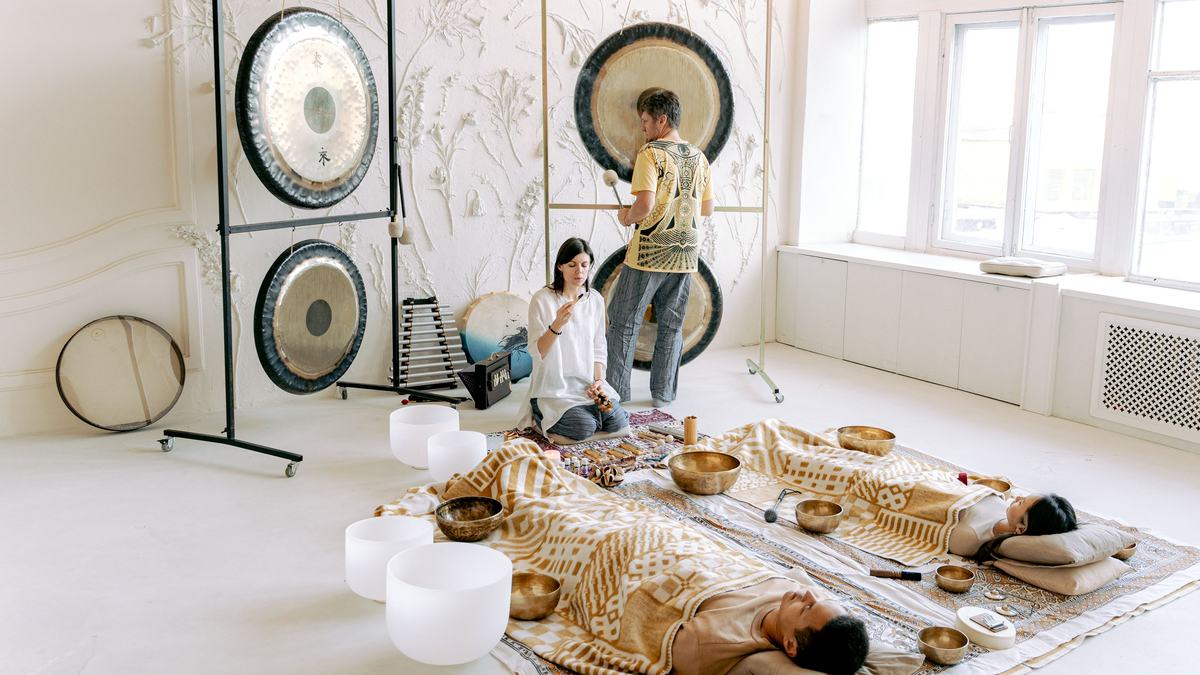
A sound bath is a group session where you lie down, get comfortable, and let instruments like gongs, singing bowls, tuning forks and drums play around and through the room. There's nothing to do. You're not "bathing" in water, you're immersed in sound instead.
There's often a moment, somewhere in the first ten or fifteen minutes, where something in the body lets go a little. The jaw unclenches. The breath lengthens. It's not that you decided to relax, more that the sound gave whatever you were holding somewhere else to go.
What Actually Happens in a Sound Bath
Most sound baths follow a loose arc: an opening (often a gong, drum, or a few minutes of settling), a longer middle section where the instruments build and layer, tibetan bowls, chimes, crystal bowls, and a closing that brings you gently back into the room before you sit up. You usually lie on a mat or blanket, fully clothed, eyes closed, for somewhere between 45 minutes and an hour.
There's no technique to learn and nothing to get right. You don't need to breathe a certain way or hold a particular thought. The instruments are doing the work; your job is just to be there and let it land however it lands.
Why Sound Affects the Body
Before it's music, sound is vibration, mechanical energy moving through air and, when you're lying close to the instruments, through the body too. That part is straightforward physics, not something I need to argue for.
Where I'm more careful is in how far I take that. Some people and some research have explored how particular frequencies relate to relaxation and focus, and my own training traces back to the Tomatis® Method, which looks at how the ear connects to the wider nervous system through the vagus nerve. I find this a genuinely useful framework for how I sequence a session. But I want to be honest that the research on any one frequency producing a specific, universal effect is still developing, not settled, and I hold it as part of my own practice, not as proven medical fact. If you'd like the fuller picture of where this thinking comes from, I've written more in what is neuro-acoustic science.
What You Might Feel (and What's Normal)
Reactions vary a lot from person to person, and most people are a little surprised by their own.
Some people feel a heaviness in the limbs, like they couldn't move even if they tried. Some notice warmth or tingling, often in the chest or hands. Some feel an emotion surface without an obvious reason, a wave of grief or relief that passes through and out again. Some people don't feel much of anything the first time, and simply sleep more deeply that night instead. Falling asleep during the session itself is common too, and isn't a failure, if anything it can mean the body felt safe enough to switch off.
There's no "correct" experience to have here, and nothing to force. Whatever shows up is the one worth trusting.
How It's Different From Meditation
Meditation usually asks you to do something, focus on the breath, watch a thought pass, return attention to a point. For people with a busy mind or a busy nervous system, that can feel more frustrating than restful.
A sound bath doesn't ask that. You don't need to concentrate or clear your mind. The sound does the organising, your job is simply to be there. That said, the two work well together for people who practise both, the quiet that follows a sound bath is often a easier place to sit still in than the quiet you start with.
Who Tends to Come
People arrive for all kinds of reasons, curiosity, a stretch of stress or a demanding season, a recommendation from a friend, or simply wanting an hour where nothing is required of them. Many describe coming during a period of feeling stretched thin, disconnected from their body, or generally overdue for a proper pause.
I want to be straightforward here: a sound bath is a complementary wellbeing practice, not a substitute for medical or mental health treatment, and it doesn't diagnose, treat or cure any condition. If you're navigating something specific and are currently under medical or mental health care, please continue to follow that practitioner's guidance alongside anything here.
Finding a Sound Bath on the Gold Coast
If you're on the Gold Coast and want to try one, I run a fortnightly sound bath circle, Keepers of Frequency, at Stellar Studio in Helensvale, capped at a small group so it stays intimate. If you'd rather a fully one-to-one experience, a private session is the more tailored version of the same thing, and if you're not sure which fits, a free 15-minute conversation is a low-pressure way to figure that out together.
A Few Common Questions
Do I need to bring anything? Just yourself. Mats and blankets are provided, so wear something comfortable and try not to eat a heavy meal right before.
What if I fall asleep? That's completely normal, and not something to apologise for.
Is one session enough to notice something? Most people notice something in a single session, though like most practices, anything it offers tends to build with regularity rather than a single visit.
Is it safe if I have a health condition? Sound baths are gentle and non-invasive, nothing is ingested and nothing enters the body. If you have a specific health concern or you're pregnant, it's worth mentioning beforehand so the session can be shaped sensibly around it.